The Underrated Power Of A Small, Focused Email List
Everyone selling an online business tells you the same thing first. Grow the list. Bigger is better. More subscribers, more reach, more chances to sell something eventually.
I believed that for years, and a good deal of what I built reflected it.
Then I watched a focused email list, built around one narrow promise, quietly outperform a far bigger one I was also running at the time.
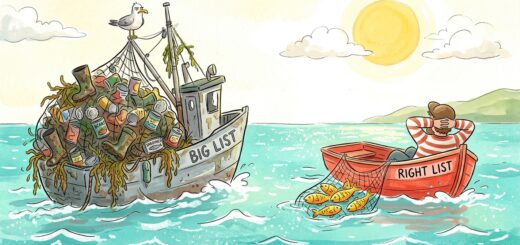
Five hundred people who genuinely care about the one thing you talk about will do more for your business than five thousand who signed up for something vague and barely remember joining.
If you have ever thought, ‘I’m not very techy, surely a huge following is the only way any of this works’, that is the wrong way round. Let me walk you through why. You do not need more people. You need the right ones, gathered around one clear, specific promise, starting this week rather than someday.
Why Bigger Rarely Means Better
A list built for ‘everyone interested in online business’ attracts a bit of everyone and commits to almost nobody.
Someone who signs up for ‘marketing tips’ has no particular reason to open your next email. Someone who signs up because you promised to help solve one specific problem has every reason to open it.
That difference shows up later, in how many people actually read what you send, not in how impressive the subscriber count looks on day one.
I touch on this a fair bit, in other articles I have shared recently, because it keeps coming up in different shapes. The same rule applies whether you are building a list, a membership, or just trying to get noticed in a crowded market. Specific beats general almost every time.
A painfully specific audience is easier to serve well. It is also easier to describe in one sentence, which matters more than it sounds.
A focused email list of five hundred people who actually care will do more for your business than five thousand who barely notice you are there.
Find The Question They Keep Asking
The audience is only half of it. The other half is a need that comes back.
Ask yourself what the people you want to reach repeatedly need to find, understand, avoid, or decide. Something they will still need help with next month, and the month after that.
For a lot of my own readers, the need is not learning a new piece of technology once. It is having someone explain it again, patiently, in plain English, the next time it changes. That recurring need is exactly what keeps a small, focused email list useful to the people on it, long after the first email.
Strong newsletters tend to do one of three things consistently. They make the reader money, save the reader time, or save the reader money. Pick one of those and build everything else around it.
What Happened When I Ignored My Own Advice
I did not always get this right myself, and one launch taught me the cost of skipping it.
We launched FlowMailAI on the eighth of May. That date turned out to be my fiftieth wedding anniversary, though the JV manager had no idea at the time. We did not line up many partners to promote it. I later realised there was some industry politics around that particular corner of the market, and I simply was not plugged into it. It is much the same way a newsletter fails when it is built for ‘everyone’ rather than for people already gathered somewhere specific.
We had also launched on JVZoo, when I was told afterwards it would have suited WarriorPlus far better. Wrong audience, wrong platform, both at once.
Take-up was lower than we had hoped, and I am still working on relaunching it on a different payment processor. This was one launch’s outcome, not a guarantee of how any other product performs. It was an expensive way to relearn something I already half knew. Knowing exactly who you are building for, and where they already gather, decides far more of the outcome than the product itself ever does.
That is the same lesson sitting underneath a focused email list. Find the people who are already looking for what you offer, in the place they already are, and the rest gets considerably easier.
Build One Simple, Repeatable Promise
Once you know your narrow audience and their recurring need, write the promise down in one sentence.
Something like this: every week, I help people who are starting an online business later in life. I show them one thing they can safely ignore and one thing worth their attention.
Then give the newsletter a shape readers can recognise. Three or four dependable sections beat a different structure every time. One short story or lesson. One useful tool or resource. One small action they can take that week.
Readers should eventually have a favourite section. That is a genuinely good sign, and it is much harder to achieve when the list was never aimed at anyone in particular to begin with.
Publish before it feels finished. A focused email list built around a clear promise teaches you more in its first ten issues than months of planning ever will.
Where This Can Take You Next
Once you have a small, focused list that genuinely reads what you send, the next natural question is what you build around it.
If turning that audience into an actual information publishing business is where your thinking is heading, there is a next step worth knowing about. Nick James put together a free book called Six Figures A Year In Information Publishing. It walks through the wider picture beyond the list itself, the kind of business a focused audience can eventually support.
It is worth a look if you want to see where a narrow, well-served list can lead once you decide to go further with it.
Start Smaller Than Feels Comfortable
You do not need ten thousand subscribers to make this work. You need a handful of people who feel like you wrote the email specifically for them, because, in a sense, you did.
Pick the narrowest version of your audience you can honestly describe. Name the one need that keeps returning. Write the promise in a single sentence, and build three dependable sections around it.
Talk soon,
Jennifer Caroline