Why Does Feeling Confident With Technology Take So Surprisingly Long?
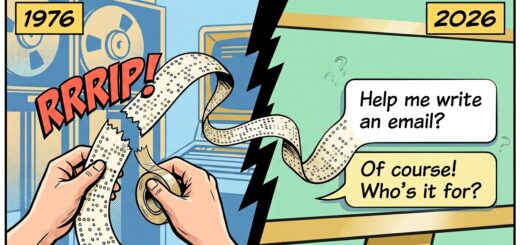
Years ago, before computers looked anything like they do now, a program I had written was punched onto a long strip of tape by a punch room. Operators then carried it through and fed it into the mainframe. If you were not on good terms with those operators, your tape could come back torn. You had to mend it before you could even try running your program again.
Waiting to see whether mine had survived the journey felt exactly like a worry I hear from so many of you now. It is the same flat, slightly embarrassed sense that everyone else finds feeling confident with technology far easier than you do. As it happens, I ended up marrying the chief operator from that very team, so it clearly worked out for me in the end. But that early feeling of not quite trusting the machine, or myself, never really left. It just changed shape. These days it turns up as AI instead of punch tape, and the worry underneath it is exactly the same one you carry now.
A Torn Tape And A Torn Confidence
I did not know, back then, whether a torn tape meant my program was ruined or simply delayed. I only knew I had to wait, hope, and try again if it failed. That is not so different from opening an AI tool for the first time and typing something in, half expecting it to misunderstand you completely.
The mechanics have changed almost beyond recognition. The feeling has not moved an inch. Learning something new in technology has always meant tolerating a stretch of not knowing, before it starts to make sense.
Think about the last time you opened a new app and stared at a blank box, unsure what to type. That blank box is this generation’s torn tape. You are waiting to find out whether the thing you are about to try will work, and you have no way to know until you try it.
Why This Still Feels So Hard
People are told AI is so easy it will do anything you ask. It is not quite that simple. AI has a short memory unless you work around it, and it needs a specific, well written prompt to give you something useful back.
Nobody tells you that part. So when your first attempt goes wrong, it is easy to assume the fault is yours, rather than a perfectly normal part of learning a new tool.
One thing I hear often, in various forms, is I am not very techy. I understand that feeling better than most people would guess. Fifty years in computing, and I still hit walls with AI that make me stop and think for a while. Feeling confident with technology is not something that arrives all at once, even for someone who has spent a lifetime around machines.
Patience, Not Talent
I have always believed everyone is given their own particular skills. For some people that is technology. For others it is drawing, sewing, sky diving, or something else entirely. Not having a natural feel for tech is not a failing. It is simply not what you were given, and it does not stand in the way of feeling confident with technology over time.
What closes that gap is not talent. It is patience, applied slowly, without giving up halfway through.
Confidence with technology has never been about talent. It has always been about practice.
I have watched people arrive on our help desk convinced they are hopeless with computers, and leave three conversations later doing things they thought were beyond them. Nothing changed about their ability. Their patience simply had somewhere useful to go.
One caller told me she had given up twice before calling back a third time. By the end of that call she was doing the thing herself, without me talking her through it step by step. That is what patience applied slowly looks like from the outside.
Stop Learning What You Will Not Use
Here is something that might be a relief to hear. You do not need to learn everything AI can do. If you will not use a skill often, you will forget it, and then you are back where you started, only more discouraged.
It is not worth learning something for its own sake. It is worth learning the one or two things you will use every week. I have written about this kind of thinking in other articles I have shared recently, and it keeps coming back to the same point: narrow beats broad, every time, for someone starting from a standstill.
Pick the task you keep avoiding. Writing an email. Sorting a spreadsheet. Drafting a description for something you are selling. Learn to do that one thing with AI, properly, and let everything else wait.
Say the task you avoid is writing emails to your list. You do not need to learn every AI writing tool that exists. You need one tool, and one habit, built around that single task, until it stops feeling like a chore.
One Small Habit That Works
Choose a single AI tool. Use it for the same small task, at the same point in your week, for a fortnight. Not different tools for different jobs. One tool, one job, repeated until it stops feeling strange.
Not sure where to start? My free Smart AI Toolkit has a handful of beginner-friendly tools to choose from, such as the Beginner Income Idea Builder or PLR Rebrand Studio, and new ones are added every month. Just pick one. Only one.
By the second week, something shifts. Not because the tool got easier. Because you got more familiar with it, the same way any new thing eventually stops being new.
That is the whole method. No course, no manual, no giant leap. Just the same small habit, kept up longer than feels comfortable at first.
You Are Not Behind
Internet marketing seems to have turned into AI anything almost overnight. Even I struggle to keep pace with it some weeks, and I have been doing this since long before Google could answer a question for you.
If you feel behind, you are not behind. You are simply standing where everyone stands, right before something starts to click. Give it the same patience that mended a torn tape all those years ago, one small, deliberate step at a time.
Start with one task. Repeat it. Let feeling confident with technology build the slow way. It is the only way it ever really has.
Talk soon, Jennifer Caroline