Why Human Trust Is the Essential Skill AI Has Overlooked
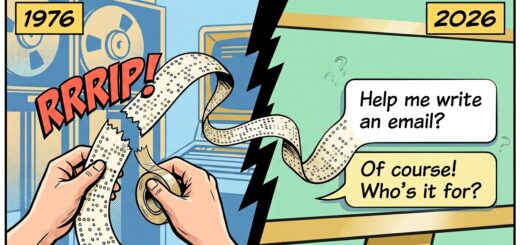
I’ve spent over fifty years around computers, since the days when a program had to be punched onto tape by hand before an operator would feed it into the computer. So when I tell you that even I am struggling to keep pace with AI right now, I mean it. It’s more than a throwaway line about getting older.
Something has been building quietly in my corner of the internet marketing world. Every week brings another tool promising to write your emails, build your website, or run your business while you sleep. My inbox is full of it. And yet the people I hear from most tell me something different. They come through the Promote Labs help desk, where I’ve worked for ten years now, and they aren’t asking for a cleverer robot at all. They’re telling me the same thing they always have.
‘I’m not very techy,’ one will say, almost apologetically, as if it’s something to be ashamed of. Another admits that even when a thing is explained to them properly, it sometimes ‘doesn’t click,’ and they’re left feeling further behind than before they asked.
That gap is where human trust lives, and it might be the most valuable thing any of us has to offer right now.
When Explaining Isn’t the Same as Understanding
There’s a difference between information and understanding, and AI is very good at the first and still hopeless at the second.
Ask any AI tool a question and it will answer instantly, confidently, and usually correctly. What it can’t do is notice that you’ve gone quiet. It can’t tell that your last three questions were really the same question asked in different words, because the first answer didn’t land. It can’t slow down when someone is close to giving up.
I see this constantly on the help desk. Someone writes in convinced they’ve broken something, when really they just needed one sentence rephrased without the jargon. The fix is rarely technical. It’s patience. Last month someone wrote in three times about the same setting, each message a little more anxious than the last, because the first two answers used words that meant nothing to her. The fourth reply, the one that finally worked, said the same thing in plain English and took me two minutes longer to write. That’s human trust in practice: noticing when an answer hasn’t landed, and trying again without making the person feel slow for asking.
Even I Can’t Keep Up, and That’s the Point
I’ve been in computing since before most of today’s tools existed, back when a torn punch tape meant your whole program had to wait until it was mended. That’s the same feeling a lot of you have with AI moving faster than anyone can reasonably follow. I feel it too, not despite fifty years in this industry but because of them.
Internet marketing has turned into ‘AI anything’ seemingly overnight. Things like information publishing and simple digital products, which have been my own bread and butter for years, seem to have vanished from the conversation. New models, new platforms, new terminology, every month.
If someone with fifty years of computing behind her can feel like she’s chasing a train that’s already left the platform, that’s worth noticing. You are not failing by feeling exactly the same way. The mechanism doesn’t change just because the tools got smarter. When things move faster than anyone can master them, that’s when it matters most. The one thing that still steadies people is a human willing to slow down and explain it properly. It does that without a lecture, and without making people feel small for asking.
That’s where the real opportunity is hiding, and it has nothing to do with learning every new AI feature before it changes again.
The Skill Nobody Is Teaching
People are told AI is easy and will do anything for them, which sounds wonderful until you’re the one sitting there with a blank screen. Then you’re wondering why the answer it gave you doesn’t work for your situation. AI has a short memory unless you know how to work around it. Getting a useful result usually depends on asking it the right way in the first place. Nobody tells beginners that part.
I’ve always believed everyone has their own given skills and talents. For some people that’s tech. For others it’s drawing, sewing, patience with people who are struggling, or the ability to explain something twice without a hint of irritation the second time. Not having a natural gift for tech isn’t a failing. It’s simply not what you were handed, and that’s fine, because somebody else’s patience can fill that gap for you. And yours can fill it for someone else.
The one thing that still steadies people is a human willing to slow down and explain it properly.
I’ve written a bit more about how this shift is playing out, in other articles I’ve shared recently, if you want to see where else it shows up.
What This Means If You’re Building Something Online
You might be building an online business and worrying that AI will make you obsolete before you’ve properly started. I’d gently push back on that.
The businesses quietly becoming more valuable right now aren’t the ones with the flashiest AI features. They run on human trust instead, a real person answering the questions AI leaves people with. Coaching, support, community, and simple, patient teaching are becoming rarer precisely because everything else is becoming automated.
You don’t need to be the most technical person in the room. You need to be the one who explains things at the reader’s pace, in their place, without treating a genuine question as a stupid one. That’s a skill you already have, or one you can build faster than you think.
Start Small, and Start With What You Already Know
You don’t need to master every AI tool that launches this month to build something worthwhile. You need one problem you understand better than most people, and the patience to explain it clearly, over and over. That’s enough for the people who are stuck exactly where you once were.
Think of the one thing people already ask you about, whether it’s untangling an email inbox, choosing between two pieces of software, or just working out where to start with a first product. That’s your beginning, not a fully finished course.
If you want a proper, unhurried look at how information publishing works, without needing to be technical, this is a good starting point. It’s called Six Figures A Year In Information Publishing. It’s a free book with no jargon, written for people who want to build something real rather than chase whatever tool is trending this week.
You won’t need to become an AI expert to make it work. You’ll need what you already have: patience, and a willingness to explain things properly.
Talk soon,
Jennifer Caroline