How to Generate Full Email Sequence Without Writing a Single Word
Every day your email list sits idle, you’re losing money. Marketers stall on campaigns because of decision overload, not laziness. What if you could generate an entire email sequence from just a URL in seconds? AI removes this friction and gets you mailing.

Key Takeaways
- Generative AI can turn a single URL into a complete, structured email launch sequence in seconds – no writing required.
- Many email campaigns face significant delays or never get sent because marketers struggle with the initial blank screen, rather than a lack of ideas or work ethic.
- Every day a list goes un-mailed is revenue left on the table – the cost of not sending is measurable and real.
- Built-in tools like subject line scoring and spam testing can significantly improve inbox placement before a single email is sent.
- Businesses using AI in email marketing have reported significant open rate improvements, with some studies showing gains of 25% or more, and click-through rate increases of 33% or higher.
Writing a full email launch sequence is one of those tasks that sounds straightforward until you actually sit down to do it. Then the questions pile up, the cursor blinks, and somehow two hours disappear without a single email getting finished. There is a better way – and it does not involve a copywriter, a swipe file, or staring at a blank screen.
The Blank Screen Is Costing You Real Money
Here is a truth most email marketing advice skips over: the blank screen has a dollar figure attached to it. Every day a list does not receive an email is a day that list earns nothing. Multiply that across weeks of delays, half-finished drafts, and campaigns that never launch, and the loss adds up fast.
Email still delivers one of the highest returns of any marketing channel. The problem is not the channel. The problem is the friction between knowing an email needs to go out and actually getting it written, structured, and sent.
Why Most Marketers Stall on Email Campaigns
Too Many Decisions, No Framework
Stalling on email campaigns is not a willpower problem. It is a decision overload problem. The moment a marketer sits down to write, they face a cascade of micro-decisions all at once:
- What goes in the first email?
- How many emails does this sequence need?
- Should this one pitch, or deliver value?
- What subject line will actually get opened?
- How does this one connect to the next?
Without a framework to answer those questions in order, the brain stalls. The result is either chronic delay or panic-copying tired swipe files that look exactly like everyone else’s campaign. Neither approach moves the needle.
The Hidden Cost of Not Sending
There is a less obvious cost that rarely gets discussed: inconsistency kills list momentum. Subscribers who do not hear from a sender regularly lose familiarity fast. Open rates drop. Spam complaints creep up. When that marketer finally does send something, the list has gone cold.
The fix is not sending more often through sheer willpower. It is removing the friction that makes sending hard in the first place. That is where AI-powered campaign generation changes the equation entirely. For a deeper look at how to structure email campaigns when you are not sure where to start, this free cheatsheet breaks it down step by step.
AI Now Writes the Entire Campaign for You
From URL to Full Sequence in Seconds
The most significant shift in email marketing right now is not a new strategy or a new platform. AI can now read a sales page and generate a complete, structured email campaign from it – automatically.
The workflow is almost unreasonably simple: paste a product URL, select a campaign type, and receive a full sequence. The AI reads the sales page, identifies the core offer and angles, and builds the emails around them. No brief, no outline, no first-draft agony.
According to a BCG study, 49% of marketing organizations are already using generative AI for content creation, with productivity gains of around 30%. That figure is rising quickly as tools become more capable and accessible.
What Gets Generated Automatically
A well-built AI email campaign generator does not just produce a few lines of text and leave the rest to figure out. What gets produced automatically includes the full email sequence structure, subject lines for every email, body copy tailored to the offer, and campaign-specific formatting – whether for a product launch, webinar series, affiliate promotion, or lead nurture sequence. The output is a ready-to-edit draft, not a starting point for another writing session.
What FlowMail AI Actually Includes
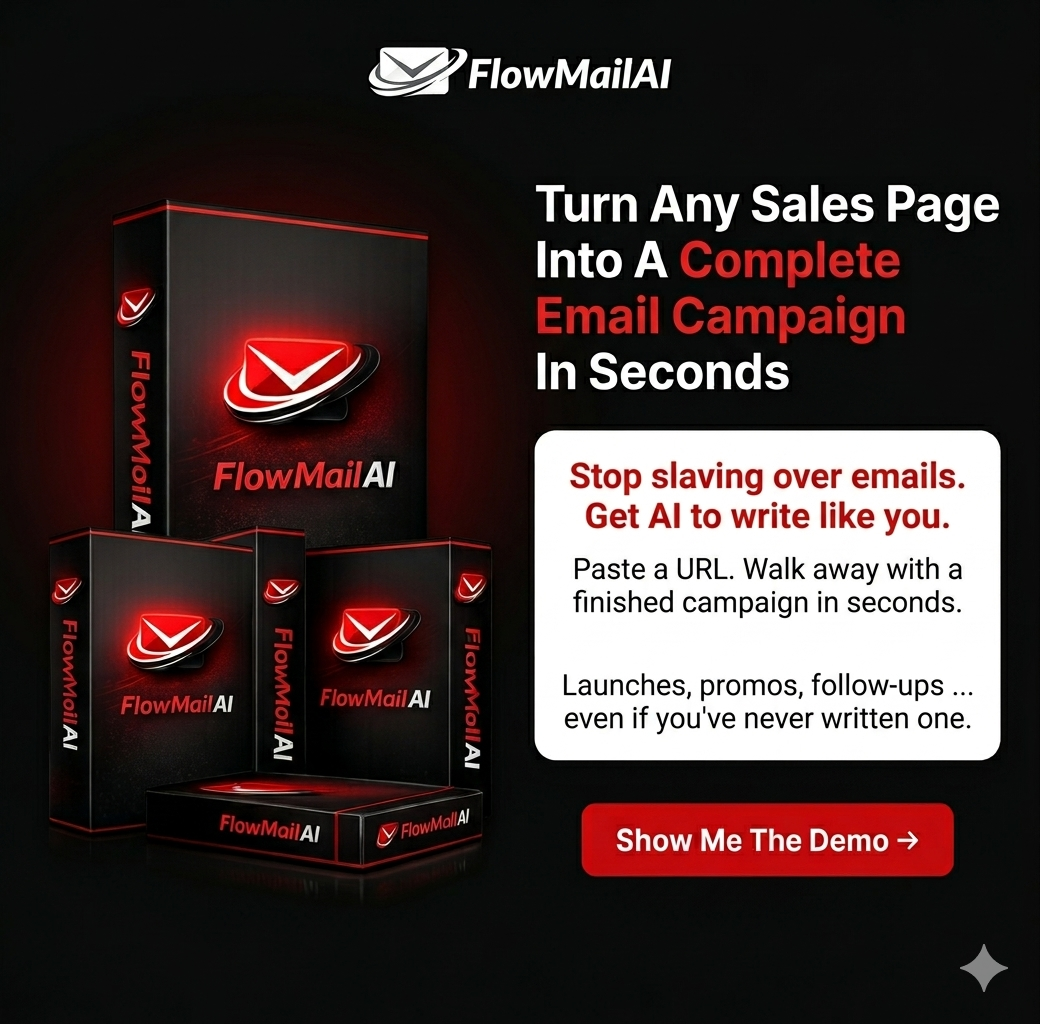
FlowMail AI is described as an advanced, fully-featured email marketing campaign creator. The vendor is listed as Richard Fairbairn. It was designed specifically around the one-URL-in, full-campaign-out workflow, and what is included reflects that purpose rather than trying to be a general-purpose AI writer.
10 Writer Styles and 25 Campaign Templates
Tone matters enormously in email. A hard-sell sequence for an affiliate promotion and a warm welcome series for a new subscriber should not sound the same. FlowMail AI includes 10 writer styles – spanning aggressive direct-response to conversational and personal – so the output matches both the offer and the audience.
The 25 campaign templates cover the structures most marketers need: product launches, affiliate promotions, webinar campaigns, lead nurture sequences, follow-up and re-engagement campaigns, and giveaway series. Each template is pre-structured around a proven sequence logic, so there is no blank page and no guesswork about what goes where.
Subject Line Scorer and Spam Testing Built In
Generating good email copy is only part of the job. FlowMail AI includes a subject line scoring tool that rates every subject line across curiosity, clarity, urgency, and spam risk – and suggests alternative lines that can be swapped in with one click. This addresses one of the most common open-rate killers: subject lines written without any signal as to whether they will actually perform.
Alongside that sits a spam testing tool that scans the email body for words, phrases, and structural patterns that trigger filters before the email is ever sent. The result is a pre-send checklist that most marketers skip entirely – not because they do not care about deliverability, but because checking manually is tedious and inconsistent.
Deliverability: Getting Into the Inbox
Spam Triggers Caught Before You Send
Even a well-written campaign earns nothing if it lands in spam. AI-powered deliverability tools use machine learning to analyze content structure, sender patterns, and engagement signals to increase inbox placement – but the most practical version of this is catching problems before they happen.
FlowMail AI’s spam checker flags issues ranked by severity, highlights positives, and provides actionable fixes. For most marketers, the pre-send content scan alone closes a major gap. Most people send and hope. Catching spam triggers before hitting send stacks the odds in a very different direction.
The Numbers Behind AI Email Marketing
The business case for AI in email is not speculative at this point. The data is consistent across multiple sources:
- Significant open rate improvements reported by businesses implementing AI email strategies, with some studies showing gains of 25% or more
- Notable click-through rate gains across similar implementations, with some research indicating increases of 33% or higher
- Over 300% ROI improvements in documented cases
- HubSpot research shows 54% of marketers save 1-5 hours weekly using AI for email tasks, with 31% saving 6-10 hours
Results from major brands confirm the direction. Sephora used AI to analyze subscriber behavior and personalize product recommendations in email, leading to enhanced click-through rates and increased revenue. AI tools can also be applied to determine optimal send times for individual subscribers, which research suggests can increase open rates. The AI email marketing segment is experiencing significant growth, reflecting its broad adoption across marketing teams of every size.
Stop Starting From Zero – Your List Can’t Wait
An email list that does not get mailed consistently is a depreciating asset. Subscribers forget why they signed up. Engagement fades. The eventual campaign that does go out lands in a colder, less responsive inbox than the one that existed six months ago.
The solution is not a better writing process or a longer swipe file. It is removing the starting-from-zero problem entirely. When a full campaign sequence – with subject lines, body copy, structure, and deliverability checks – can be generated from a single URL in minutes, the barrier that keeps most marketers from sending disappears.
The blank screen was never really the problem. The problem was having no fast, reliable path from needing to run a promotion to having emails that are ready to send. That path now exists – and ignoring it means continuing to leave money sitting in a list that never hears from you.
JenniferCTaylor.com provides resources on practical email marketing strategies, tools, and shortcuts for marketers who want to send better campaigns without starting from zero every time.